
Yogyakarta, 25 September 2025 – The Department of Urban and Regional Planning (PWK), Universitas Gadjah Mada, held a guest lecture entitled “Systems Approach to Planning” conducted offline at the Building of the Department of Architecture and Planning Engineering, Faculty of Engineering, Universitas Gadjah Mada. The lecture was open to members of the academic community as well as the general public.
On this occasion, PWK UGM invited Nicholas Phelps, Associate Dean (International) and Chair of Urban Planning, Faculty of Architecture, Building and Planning (ABP), The University of Melbourne, as the keynote speaker.
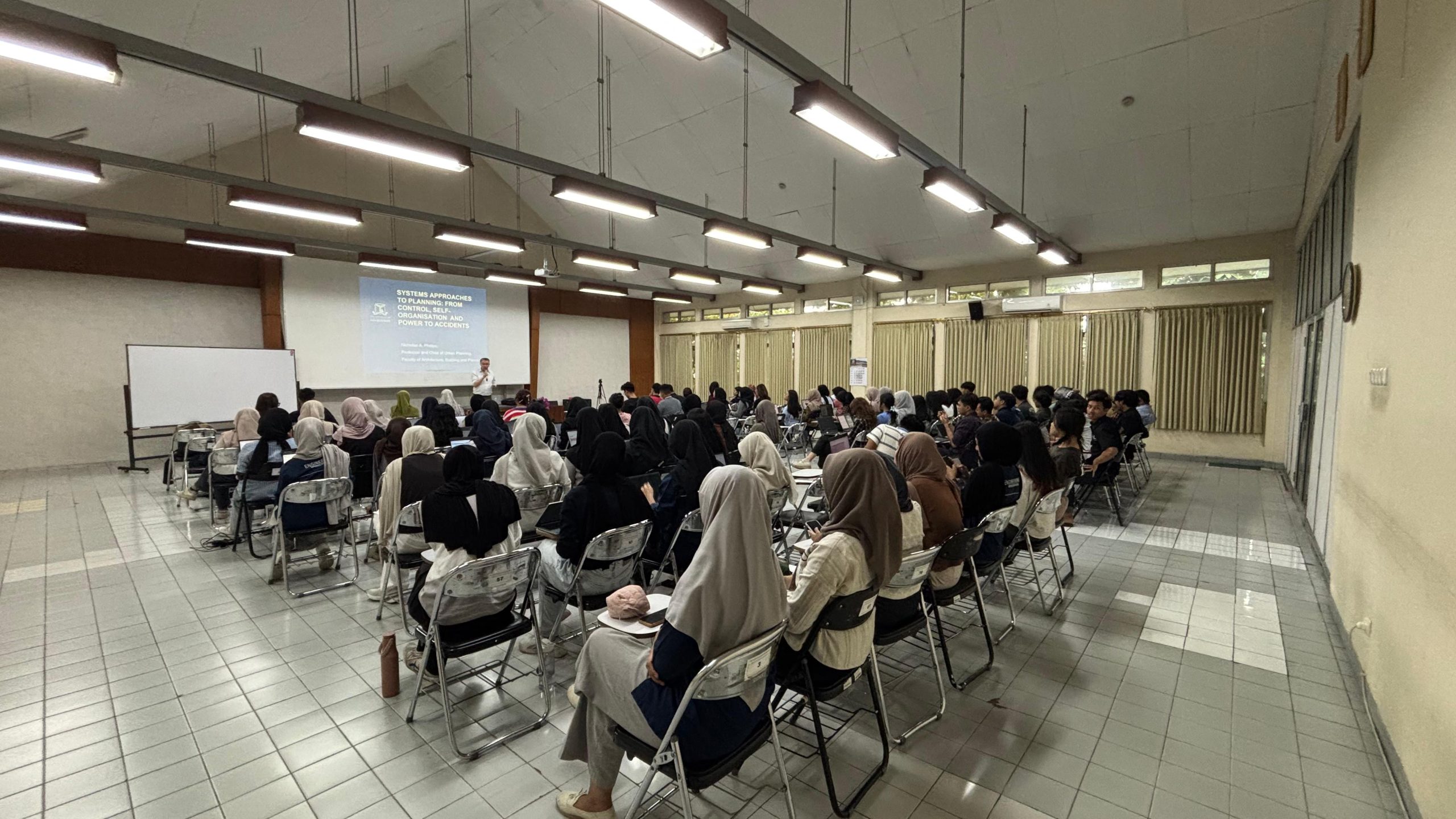
Through this lecture, Nicholas Phelps encouraged participants to examine urban planning systems through multiple analytical lenses. The discussion began with a critique of planning systems in many countries, including Indonesia, which have become increasingly complex, convoluted, and bureaucratic. Rather than simplifying urban problems, such bureaucratization often adds further layers of complexity to planning practice.
The first approach discussed was planning as a closed control system. This is the most traditional and commonly understood approach, in which planning is viewed as a rigid, top-down, and closed process. However, this approach has been widely criticized for failing to address root causes. A classic example is the construction of toll roads to alleviate traffic congestion, which in practice often generates induced demand and creates new congestion problems elsewhere.
The second approach was planning as a self-organizing system. This perspective emphasizes forecasting and adaptability, while allowing room for experimentation and trial-and-error processes. It is closely related to the concept of Smart Cities, which rely on real-time data and big data visualization to understand how cities organize themselves organically.
The third approach views planning as a system of power. From this perspective, planning systems reflect existing power structures within society, such as social class or capital. Planning decisions—ranging from land allocation to large-scale megaprojects—essentially mirror the prevailing distribution of power in the context where planning takes place.
The final approach discussed was planning as a system of “normal accidents.” This relatively recent planning theory focuses on failure, arguing that in highly complex systems such as urban planning, accidents or failures are normal and unavoidable. These failures are often associated with wicked problems or major planning disasters.
Nicholas invited participants to look more deeply into planning failures and “accidents.” He identified six key features of planning systems that tend to produce failure:
-
Complex interactions
-
Tight coupling between components
-
Unfamiliar feedback loops
-
Multiple control parameters
-
Dependence on indirect information
-
Limited understanding of processes
In the Indonesian context, planning failures are rarely discussed openly. For example, when spatial planning violations occur, the sanctions or fines imposed are often far smaller than the economic benefits gained from the violations. This reflects a form of systemic “accident” or planning failure.
Nicholas concluded that the bureaucratization of planning, which often appears “ideal,” represents a utopia of rules that can ultimately be counterproductive. Such conditions not only distance communities from their built environment, but also alienate professional planners from the core purpose of their work—serving the public interest with optimism. An excessive focus on procedural and systematic aspects of planning often causes us to overlook realities that exist beyond the systems we expect or design.
This guest lecture is relevant to several Sustainable Development Goals (SDGs), including SDG 9 (Industry, Innovation, and Infrastructure), SDG 10 (Reduced Inequalities), SDG 11 (Sustainable Cities and Communities), SDG 16 (Peace, Justice, and Strong Institutions), and SDG 17 (Partnerships for the Goals).
