Yogyakarta, July 8, 2025 – The Urban and Regional Planning Program, Faculty of Engineering, Universitas Gadjah Mada once again demonstrated its commitment to actively contributing to the field of urban and regional planning. Dr. Ir. Tri Mulyani Sunarharum, S.T., one of the faculty members of the Undergraduate Program in Urban and Regional Planning at UGM, shared valuable insights in the Pro Justicia legal talk show with the theme “Harmony of Cultural Preservation and the Right to Space in Yogyakarta Special Region (DIY).” The event was held on Tuesday, July 8, 2025, broadcast live on TVRI Yogyakarta, and organized by students of the Master of Law and Bachelor of Law Programs, Faculty of Law, Universitas Gadjah Mada.
SDGs 13-Climate Action
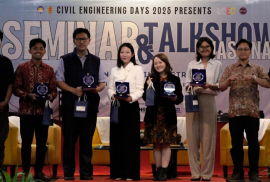
Yogyakarta, May 18, 2025 — Dr. Ir. Tri Mulyani Sunarharum, S.T., IPU, popularly known as Ibu Yani, Lecturer at the Department of Urban and Regional Planning (PWK), Faculty of Engineering UGM, was one of the speakers at the National Seminar and Talkshow of Civil Engineering Days 2025, organized by Universitas Atma Jaya Yogyakarta (UAJY) in collaboration with KAMAJAYA on Sunday, May 18, 2025, at UAJY Campus II Auditorium. The event carried the theme “Transformation of Infrastructure Development in Indonesia: Human Resources, Technology, and Sustainable Development” and brought together speakers from a wide range of related disciplines.
An integrated, safe, and sustainable transportation system is one of the main pillars of national progress. Recognizing the strategic role of this sector in boosting economic growth and improving quality of life, the government is currently drafting the National Transportation System Bill. This bill is expected to address existing challenges and seize opportunities in transportation to help achieve the national target of 8% economic growth.
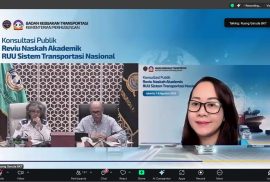
To strengthen the academic manuscript and the draft bill, Dr. Tri Mulyani Sunarharum, lecturer at the Department of Architecture and Planning, Faculty of Engineering, Universitas Gadjah Mada, and representative of the Asosiasi Sekolah Perencanaan Indonesia (ASPI), provided strategic recommendations. Her input was delivered during an online conference held on Thursday, August 7, 2025, starting at 1:00 PM (WIB). The involvement of academia in the policy-making process demonstrates the importance of synergy between education, government, and other stakeholders.
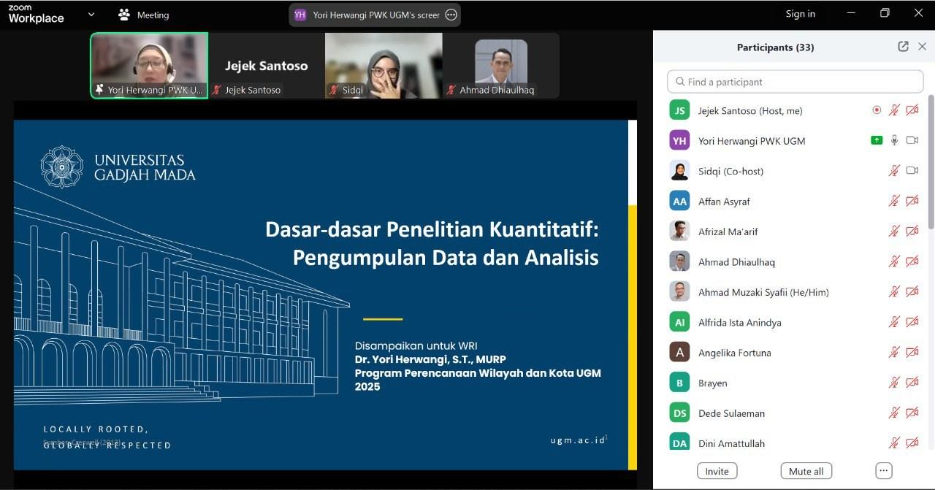
July 23, 2025 – Dr. Yori Herwangi, S.T., M.URP., served as a guest speaker in a training session organized by the World Resources Institute (WRI) Indonesia, a research organization known for its approach of “Count It, Change It, and Scale It” in driving impact through data-based research. The training was held online via Zoom from 10.00 to 12.00 WIB.
In this session, Dr. Yori presented a topic titled Basic Applied Quantitative Research: Data Collection and Analysis. She began by introducing the fundamentals of quantitative, qualitative, and mixed-method research, explaining their characteristics and types. She then delved into quantitative analysis methods, covering descriptive and inferential statistics. The presentation also included explanations of univariate, bivariate, and multivariate statistics, supported by real-world examples to help participants better grasp the concepts.
Amid the growing concerns around mental health in major cities, a crucial question arises: are our cities truly designed for people?
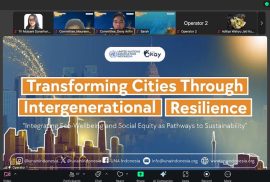
July 20, 2025—Addressing this issue, Dr. Ir. Tri Mulyani Sunarharum, S.T., a lecturer and researcher from the Department of Architecture and Planning, Faculty of Engineering, Universitas Gadjah Mada, delivered a powerful message in a national discussion forum titled Transforming Cities Through Intergenerational Resilience: Integrating Eco-Wellbeing and Social Equity as Pathways to Sustainability. The event, initiated by I AM OKAY X UNA Indonesia, was held via Zoom and brought together speakers from various disciplines, all with a shared concern for sustainable urban development.
In response to the challenges of climate change and energy efficiency in tropical urban environments, the Department of Architecture and Planning, Faculty of Engineering, Universitas Gadjah Mada (UGM) has conducted an experimental study focused on the implementation of a green wall system on a campus building. The research, titled “Effect of Greenwalls on Building Energy Use and Urban Heat Island: Insights from a Campus-Based Case Study on Facade Systems, Plant Performance, User Perceptions, and Social-Educational Impact,” provides an in-depth evaluation of the vertical garden installed on the east-facing facade of the Department’s three-story building, examining its technical, environmental, and socio-educational impacts.
Pushing the boundaries of classroom learning and cross-disciplinary collaboration, a revolutionary course is redefining how students engage with real-world construction challenges. The Undergraduate Architecture Program at Universitas Gadjah Mada (UGM) reaffirmed its commitment to sustainable architectural education through the launch of a special course titled Sustainable Materials and Construction. Delivered in the even semester of the 2024/2025 academic year, the 3-credit course was developed in collaboration with the Department of Civil and Environmental Engineering (Integrated Engineering) at Universiti Teknologi PETRONAS (UTP), Malaysia, and officially commenced at the end of May 2025. Far beyond blueprints and design theory, this course offers a holistic view of the construction industry—integrating architecture, civil engineering, and environmentally conscious technology.
Efforts to find sustainable solutions in architecture are no longer limited to land-based development, but now also extend to coastal and marine environments. In response to this growing challenge, the Undergraduate Architecture Program at Universitas Gadjah Mada (UGM) has partnered with the University of Nottingham Malaysia (UNM) and Universiti Teknologi PETRONAS (UTP) to offer a collaborative elective course titled Floating Architecture. The course was held during the even semester of the 2024/2025 academic year, and was designed to broaden students’ perspectives on the potential for human life at sea, and how architecture can contribute sustainable solutions in this context.
Students of PPAr UGM had finished submitting their design proposals for C40: Reinventing Cities Competition. Accordingly, the students had also completed their journey in participating the Professional Studio II course as they now wait for announcements from the competition. To end the course, on its final exam as well as its final display, the students presented their designs to their supervisors and two guest architects: Ar. Syaref Pramono,S.T. IAI., AA and Ar. Aditya Noor Hadhy Utama, S.T., M.Ars., IAI.
Weaving is one of the most common architectural elements that has been used for centuries in Indonesia. Typically made from bamboo and known as gedhek in Javanese, weaving has traditionally served as walls or partitions in vernacular houses. Today, weaving is no longer limited to traditional homes—it can also be applied in various building typologies such as cafes, hotels, airports, and more. With innovations in materials, weaving can now be adapted to suit specific aesthetics or functions desired in architectural design. BYO Living, a renowned weaving studio from Indonesia, shared their insights on weaving in the MateREALity class (Materiality in Architecture), joined by two practitioners: David Hutama (Nenun Ruang) and Rony Gunawan Sunaryo (rgA studio), on Friday, May 16, 2025, at Room K1, Department of Architecture and Planning, Faculty of Engineering, Universitas Gadjah Mada. The discussion was led by Mutiara Angel Simanjuntak, an undergraduate student of the Architecture Program, class of 2023, who served as the moderator.