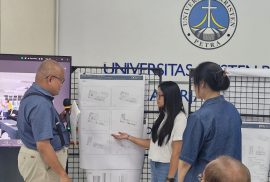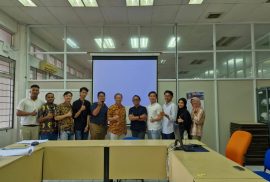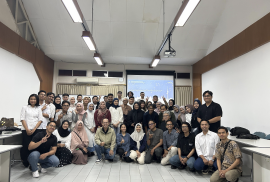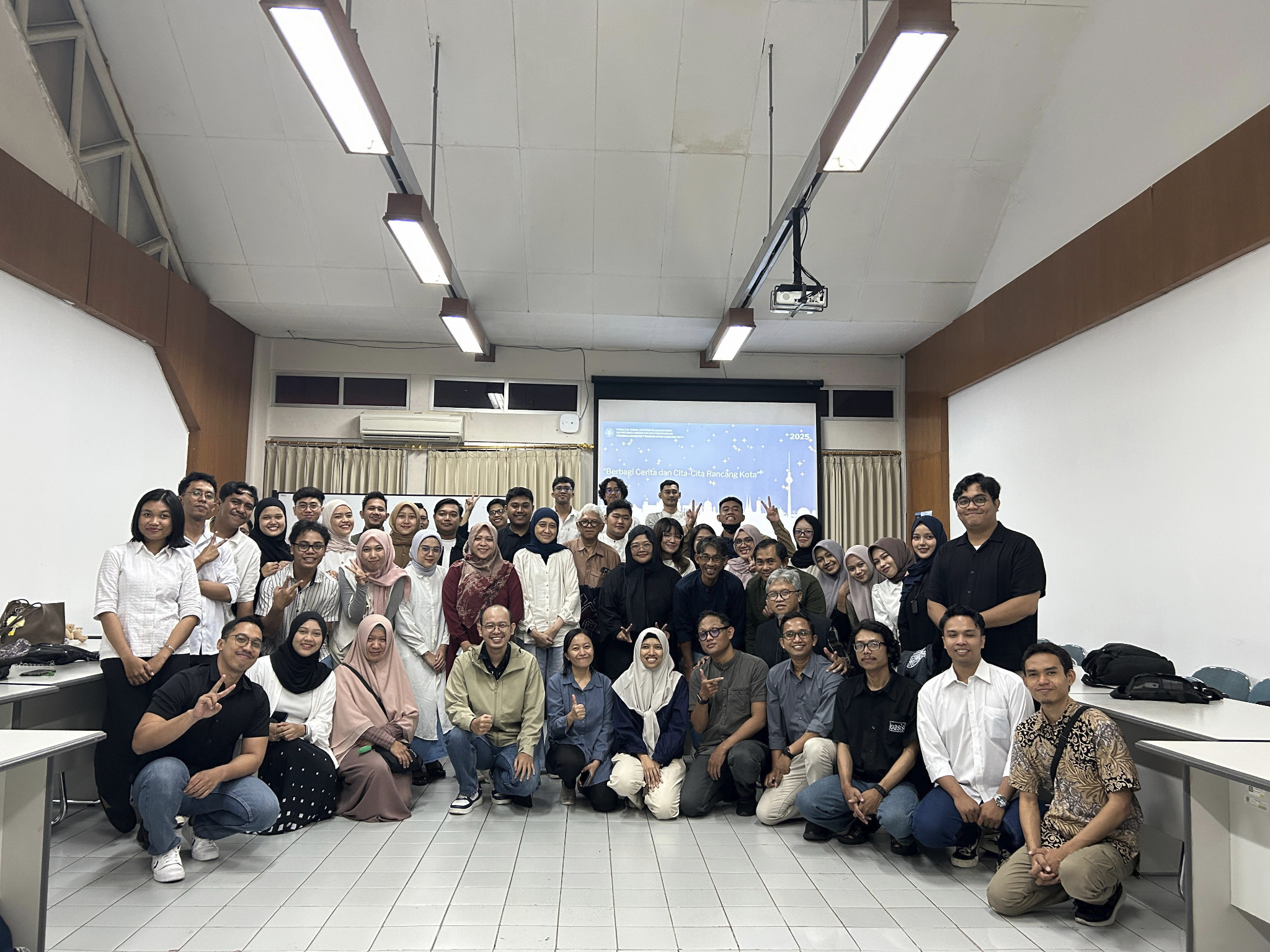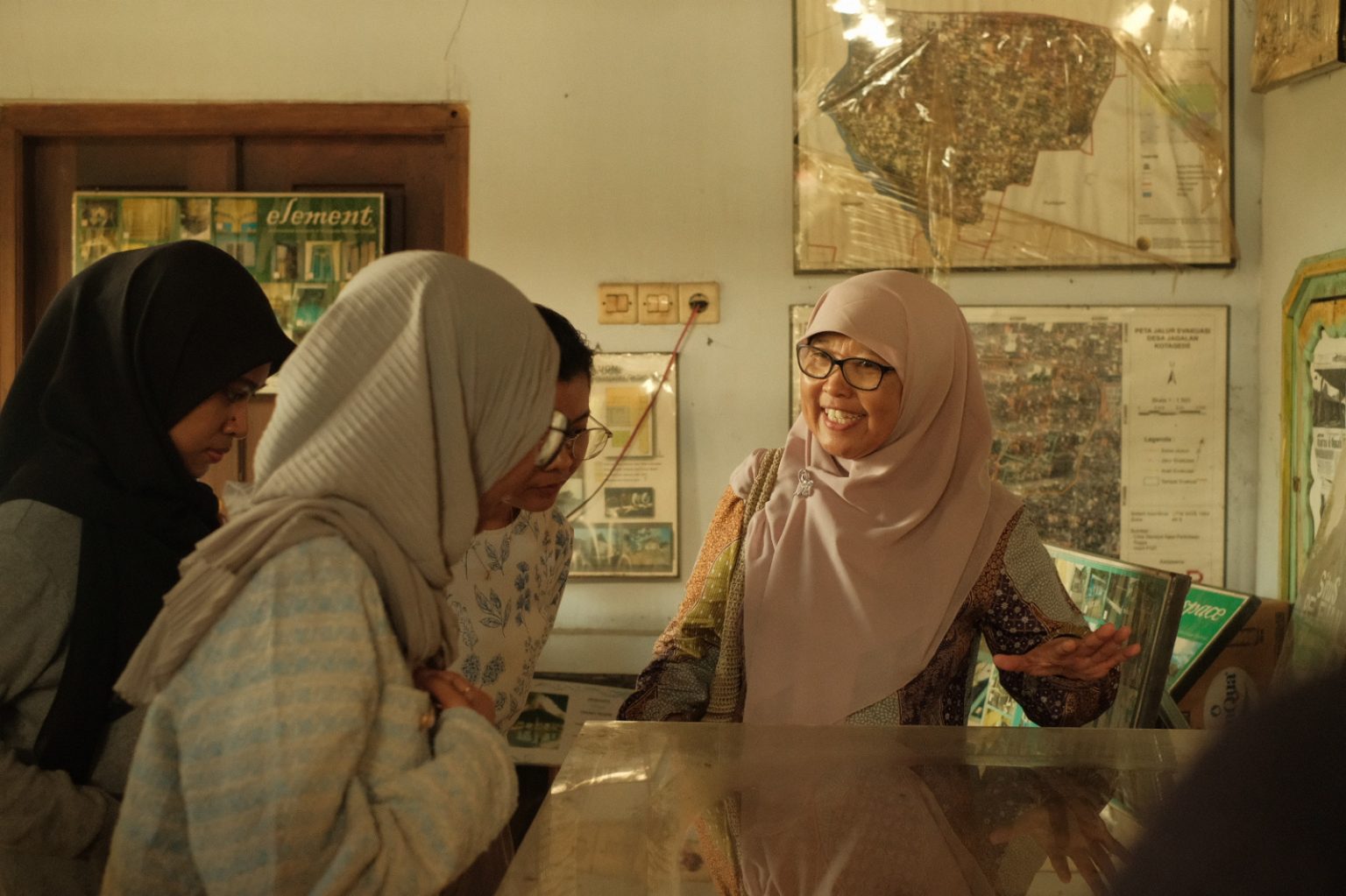
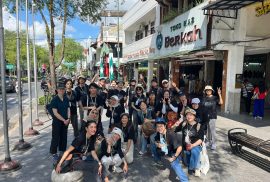
From May 16 to 20, 2025, the sixth cohort of the Master of Urban Design program (2024 intake) conducted a field observation and Focus Group Discussion (FGD) as part of the co-creation tactical placemaking phase in the Comprehensive Exploration Studio course. The project was themed Designing a Low-Emission Area in the Sanur Coastal Region, under the supervision of Dr. Ikaputra and Prof. Bambang Hari Wibisono. This academic activity was part of a collaborative initiative between the World Resources Institute (WRI) Indonesia and Pustral UGM (Center for Transportation and Logistics Studies), involving active participation from local communities and key stakeholders.
SDGs 4-Quality Education
On Tuesday, April 22, 2025, the Master of Urban Design Program at Universitas Gadjah Mada invited Ardhyasa Fabrian Gusma, S.T., M.Sc. as a guest lecturer for the Urban Design Methods course. The lecture was held on-site in classroom 1, 3rd floor, and was a mandatory session for first-semester students of the even-year 2024 intake.
During the session that aligns with the achievement of SDG 4 (Quality Education) and SDG 9 (Industry, Innovation, and Infrastructure), Ardhyasa discussed the concept of change, including shifts in ways of thinking, infrastructure transformation, and broader urban changes. He shared his personal experiences and projects that have successfully contributed to positive transformation in their respective contexts, offering students a grounded understanding of change in urban design practice.
Master’s students from the 2024 cohort of the Architecture Program at Universitas Gadjah Mada conducted a field study and research in Samiran Village, located in Selo Subdistrict, Boyolali Regency, Central Java. The activity took place over three days, from May 15 to 18, 2025, as part of the Research Methodology 2 course, taught by Prof. Ir. Tarcicius Yoyok Wahyu Subroto, M.Eng., Ph.D., IPU., Prof. Ir. Sudaryono, M.Eng., Ph.D., IPU., and Mario Lodeweik Lionar, S.T., M.Sc., Ph.D.
During the fieldwork, students engaged in a phenomenological study, conducting various observations to explore architectural issues and phenomena across micro, meso, and macro spatial scales within the local context. The activity served as hands-on practice for students in applying qualitative research methods, using approaches such as naturalistic inquiry, phenomenology, semiotics, and hermeneutics. In addition to supporting the students’ academic learning, the field study and research in Samiran Village aimed to contribute to the development and sustainability of local settlements, while maintaining respect for the area’s cultural heritage. This activity is aligned with the achievement of several Sustainable Development Goals, particularly, SDG 4 – Quality Education, SDG 9 – Industry, Innovation and Infrastructure, SDG 11 – Sustainable Cities and Communities.

Yogyakarta, 15 Mei 2025 – Kuliah tamu terbuka untuk umum yang diadakan oleh Program Studi Sarjana PWK UGM hadir kembali pada Kamis 15 Mei 2025 dengan judul “Youth Migration and Its Implication for Regional Development”. Kuliah ini mengundang Meirina Ayumi Malamassam, Ph.D, seorang peneliti di Pusat Riset Kependudukan, Badan Riset dan Inovasi Nasional (BRIN).
Kuliah tamu dibuka oleh Sri Tuntung Pandangwati, ST., MUP. selaku dosen pengampu mata kuliah Teori Kependudukan dan dilanjutkan dengan pemaparan materi oleh narasumber.
Sleman, May 8, 2025 — Second-semester students of the Architecture Study Program at Universitas Gadjah Mada (UGM), class of 2024, participated in a field trip as part of the Building Systems and Construction (SBK) course. The visit took place at the construction site of a new building for the Faculty of Agricultural Technology (FTP) UGM. This activity serves as an integral part of the learning process, aiming to introduce students to the technical and systematic realities of building construction.
Yogyakarta, May 12, 2025 – Another remarkable achievement has been made by a Universitas Gadjah Mada (UGM) student on the international stage. A UGM architecture student has won an award in the Young Artist Prize Sakura Pigma Art Contest 2025, a global art competition held online. With the theme “Joy in My Studies,” the artwork reflects a personal journey toward higher education at UGM, presented in a captivating artistic style.
Using KOI Sakura watercolor and Micron Sakura pens, the artwork depicts a woman carrying an architect’s tube accompanied by a wooden dragon heading toward UGM’s campus. The background, portraying the road to UGM, is illustrated from a bird’s-eye perspective, creating a profound narrative and visual impact. This artwork not only showcases technical expertise in visual arts but also conveys themes of optimism and enthusiasm for pursuing education.
Friday, May 9, 2025, Architecture Program of Department of Architecture and Planning (DTAP) UGM welcomed Ar. Budi Sumaatmadja in its iconic ‘Red Brick’ Campus. Ar. Budi Sumaatmadja, the principal architect of Anggara Architeam, was invited to be a guest reviewer for PPAr (Professional Architect Program) UGM and to be a speaker for Archilecture with the title ‘Architectural Inspiration for SDG’s.’
The agenda was started with Ar. Budi Sumaatmadja reviewing the design progress of the students from PPAr UGM in the morning. Each group presented their proposed design for the C40: Reinventing Cities Competition. The review was conducted in Room K5 DTAP and were also attended by the two external architects who acted as the main supervisors for Professional Studio II: architect Rezza Rahdian, S.T. and architect Widi Cahya Yudhanta, S.T., M.Sc., and Dr. Eng. Alexander Rani Suryandono, S.T., M.Arch, the head of PPAr UGM.
A guest lecture organized by the Master’s Program in Architecture was held on May 5, 2025, featuring Prof. Dr. Mark Hampton (Emeritus Associate Professor, University of Kent, UK) as the speaker. He delivered a lecture titled “Planning Island Tourism in Indonesia: Opportunities and Challenges.” The session was attended in person by all students from the 2024 cohort and was also accessible to the public through an online platform. Diananta Pramitasari, S.T., M.Eng., Ph.D., as the Head of the Architecture Program, accompanied the event and served as moderator.

In April 2025, two graduate students from the 2024 cohort of the Master’s Program in Architecture conducted a field visit to Kotagede, Yogyakarta. This visit was part of the learning process for the Architecture Studio 2 course. During the visit, the students were accompanied by Prof. Ir. Tarcicius Yoyok Wahyu Subroto, M.Eng., Ph.D., IPU., the course supervisor, and Erwito Wibowo, a local writer and cultural figure from Kotagede.
Through this visit, students learned to observe and understand the various phenomena of communal spaces present in Kotagede. To capture these phenomena, the students explored and analyzed various aspects of Kotagede, including its history, architecture, cultural heritage, and the communal spatial values that have long been established in the area.
On January 24, 2025, the Doctoral Program in Architecture at the Department of Architecture and Planning, Faculty of Engineering, Universitas Gadjah Mada held a Closed Doctoral Defense for Ph.D. candidate Tri Endangsih. Her dissertation is titled “A Conceptual Design Model of Hybrid Housing in Transit-Oriented Development Area of Railway Stations (Case Study: Jatinegara Station).”
The urgency of this research lies in the importance of developing innovative urban spaces in high-density areas. A conceptual model of hybrid housing in such areas offers an alternative solution to improve the performance of mixed-use residential environments (residential, commercial, and public facilities) where diverse functions and resident strata can coexist. In the context of urban planning, hybridity connects people and activities across multiple high-mobility zones by emphasizing corridors and linking areas to form an integrated and complex urban space. This research aims to develop a conceptual model of hybrid housing in the development of the Jatinegara Station Transit-Oriented Development (TOD) area using the hybrid architecture approach to optimize the use of urban land.