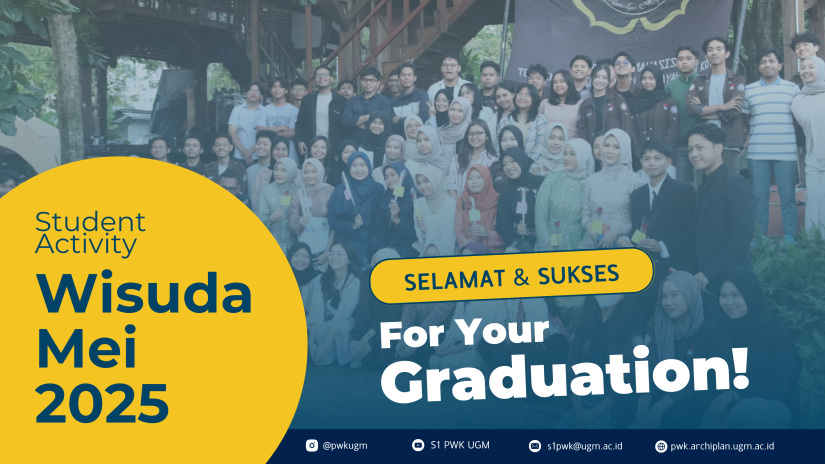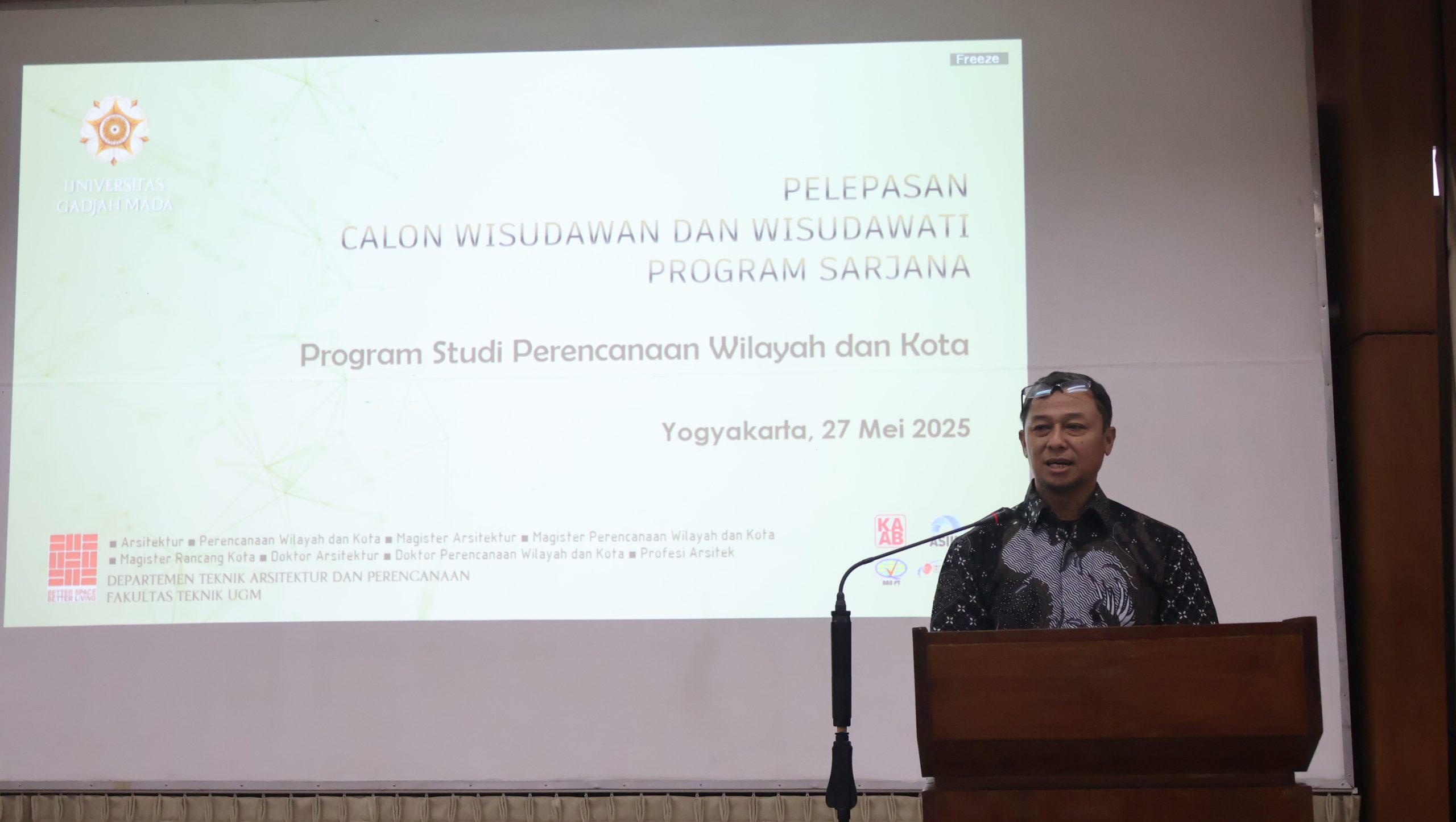
Tuesday, May 27th 2025 – The Department of Architecture and Planning, Faculty of Engineering Universitas Gadjah Mada held a graduation ceremony for prospective graduates of the Urban and Regional Planning Program (URP). Taking place in Room K1 on the 2nd floor, the event began at 1:00 PM with the national anthem Indonesia Raya, followed by a solemn rendition of the Gadjah Mada Hymn. The ceremony was attended by graduates and their families, faculty members, administrative staff, and representatives from the student association HMTPWK.
SDGs 8-Decent Work & Economic Growth
Coinciding with the celebration of Kartini Day on Monday, April 21, 2025, the Institute Tourism International held a webinar titled Top Indonesian Women in Tourism Virtual Summit with Top Expert 2025, featuring remarkable women who are experts in the field of tourism. On this occasion, Professor Ir. Wiendu Nuryanti, M.Arch., Ph.D., a professor in the Doctoral Program of Architecture at DTAP FT UGM, participated as one of the speakers and presented a talk entitled Is Tourism A Driver of Gender Equality?
Yogyakarta, May 24, 2025 — The Master Program in Urban and Regional Planning (MURP), Faculty of Engineering, Universitas Gadjah Mada (UGM), welcomed a delegation from the China Center for Urban Development (CCUD) to explore potential collaboration in the field of smart and sustainable city development.
The delegation, led by Mr. Liu Qiang, Deputy Director General of CCUD, and Ms. Zhao Fanfan, Director of the Digital Economy Office within the Smart and Low-Carbon Development Division, was received by Dr. Eng. Muhammad Sani Roychansyah, S.T., M.Eng., and Dr. Ir. Tri Mulyani Sunarharum, S.T., Head and Secretary of the MURP Program. The meeting served as a platform to exchange insights and identify opportunities for future cooperation in areas of urban innovation, planning, and policy.

Yogyakarta, 15 Mei 2025 – Kuliah tamu terbuka untuk umum yang diadakan oleh Program Studi Sarjana PWK UGM hadir kembali pada Kamis 15 Mei 2025 dengan judul “Youth Migration and Its Implication for Regional Development”. Kuliah ini mengundang Meirina Ayumi Malamassam, Ph.D, seorang peneliti di Pusat Riset Kependudukan, Badan Riset dan Inovasi Nasional (BRIN).
Kuliah tamu dibuka oleh Sri Tuntung Pandangwati, ST., MUP. selaku dosen pengampu mata kuliah Teori Kependudukan dan dilanjutkan dengan pemaparan materi oleh narasumber.
Yogyakarta, May 15, 2025 – The Undergraduate Program in Urban and Regional Planning (PWK) at Universitas Gadjah Mada, in collaboration with the Master’s Program in Urban and Regional Planning, held another online guest lecture on Thursday, May 15, 2025, titled “Innovation Challenges in the Economic Development of Yogyakarta City.”
The lecture featured Agustin Wijayanti, S.Si., M.Ec.Dev., Head of the Planning Division of the Yogyakarta City Development Planning Agency (Bappeda). The session was moderated by Dr. Eng. Ir. Muhammad Sani Roychansyah, S.T., M.Eng., lecturer of the Urban Economics course. The event was attended by students from both the undergraduate and master’s programs of Urban Economics, and was also open to the public.

Yogyakarta, April 29, 2025 – The Undergraduate Program in Urban and Regional Planning (PWK) at Universitas Gadjah Mada held a guest lecture on Tuesday, April 29, 2025, titled “The Future Outlook of Smart Cities in Indonesia: Opportunities and Challenges.”
The guest lecture featured Hari Kusdaryanto, Chief Innovation Officer (CIO) of Citiasia Inc., who thoroughly discussed the opportunities and challenges surrounding the implementation of smart city concepts both now and in the future. The event was conducted online and was open to the general public.

Yogyakarta, April 29, 2025 – The Undergraduate Program in Urban and Regional Planning held another guest lecture on Tuesday, April 29, 2025. This edition focused on the theme “Gender Empowerment and Development”, featuring Kiana Puti Aisha, S.PWK, M.A., a Development Practitioner and Policy Partnership Manager for Indonesia – Investing in Women, as the guest speaker.
This guest lecture aimed to explore the role of gender in the context of planning and development, how gender-related issues such as gender equality influence planning policies and practices, and the dynamics and challenges involved.

Yogyakarta, April 23, 2025 – The Undergraduate Program in Urban and Regional Planning held a guest lecture on Wednesday, April 23, 2025, titled “Mainstreaming the Role of Coastal Communities through the OECM Approach”, featuring Faridz Rizal Fachri, S.Kel, M.Si., a practitioner and Program Manager at the Yayasan Pesisir Lestari, as the guest speaker.
The lecture was held virtually and was attended by students from the Urban and Regional Planning Undergraduate Program at UGM as well as members of the general public.

Yogyakarta, April 24, 2025 – The Undergraduate Program in Urban and Regional Planning once again held a guest lecture in collaboration with a practitioner, conducted on Thursday, April 24, 2025. This edition of the guest lecture carried the theme “Learning from Kampung Akuarium” in North Jakarta and featured Elisa Sutanudjaja, Executive Director of the Rujak Center for Urban Studies, as the invited speaker.
The lecture invited participants to explore valuable lessons from Kampung Akuarium—how the concept of community-based and inclusive kampung susun (vertical village housing) was implemented, along with the various dynamics faced before, during, and after its development.

Tuesday, March 25, 2025 – Ir. Ikaputra, M.Eng., Ph.D., attended and delivered opening remarks as the Head of the Center for Transportation and Logistics Studies (PUSTRAL) UGM at a webinar titled “Modern Project Management in Transportation Infrastructure Development.” The event was organized by PUSTRAL UGM and held online via Zoom Meeting, with a live broadcast on PUSTRAL UGM’s YouTube channel.
In his remarks, Ir. Ikaputra emphasized that transportation infrastructure development serves as the backbone of economic growth and equitable regional development. Projects such as toll roads, railways, ports, and airports not only enhance interregional connectivity but also help reduce logistics costs and promote the tourism sector. Given the complexity of infrastructure projects, an innovative, integrated, and efficient project management approach is essential.