
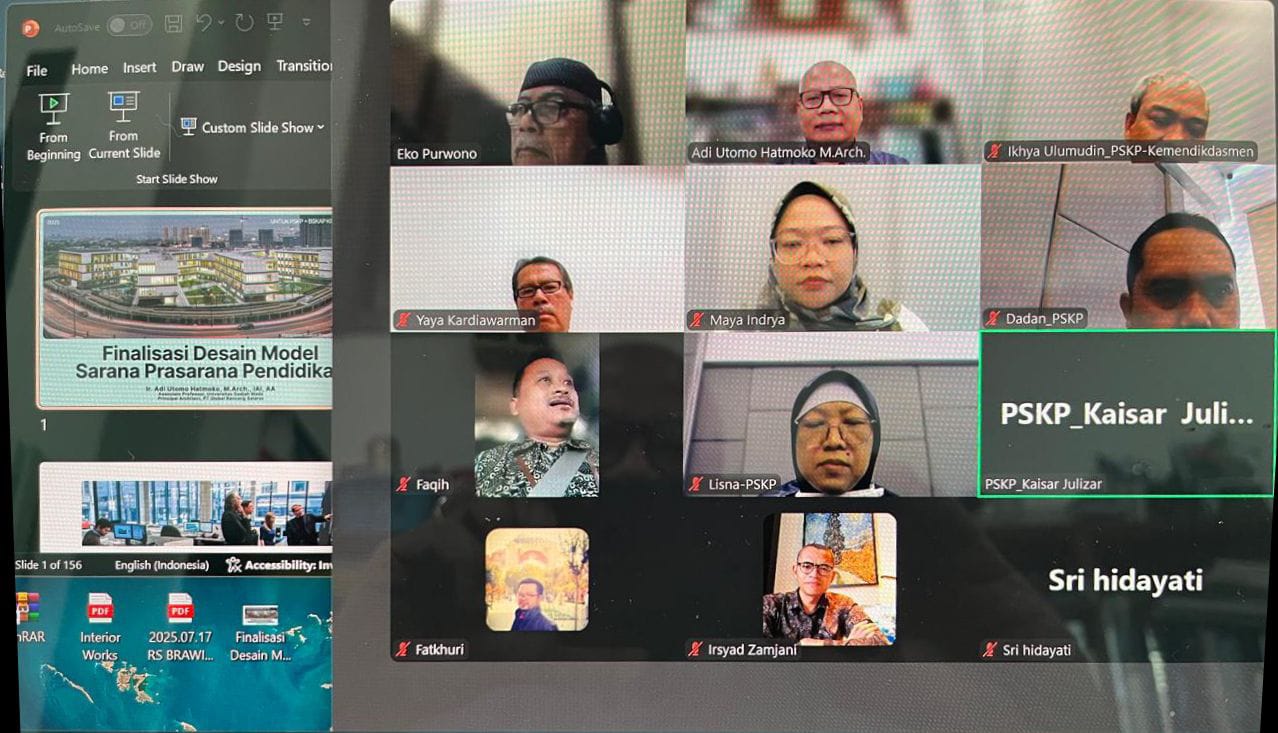
A school should not only be a place for learning, but also a joyful and safe space that nurtures every child’s growth and potential. With the implementation of Indonesia’s 13-year compulsory education program, schools have truly become a second home for the nation’s children. Responding to this need, Kementerian Pendidikan Dasar dan Menengah, through Pusat Standar dan Kebijakan Pendidikan, has developed a new design model for educational facilities, an important step toward a more humane and higher-quality education system.
SDGs 11
On Friday, July 11, 2025, the first thesis defense for the Architectural Design Concentration (Class of 2023) was held in the Master of Architecture Program at Universitas Gadjah Mada. The first student to successfully complete his thesis was M. Afi Tegar Ramadhan. His thesis topic responded to the challenges of designing schools in dense urban areas by simulating 10,400 classroom scenarios to develop a design guideline based on natural lighting and adaptive thermal comfort.
Three design alternatives were generated and tested within the context of the existing site. The findings revealed that applying a Window-to-Wall Ratio (WWR) of 30–40%, a 2.5% skylight, and operable window openings up to 16.5%could improve natural lighting performance by up to 700% compared to existing classrooms. Adaptive thermal comfort strategies were achieved by maintaining airspeed between 0.6–1.2 m/s.
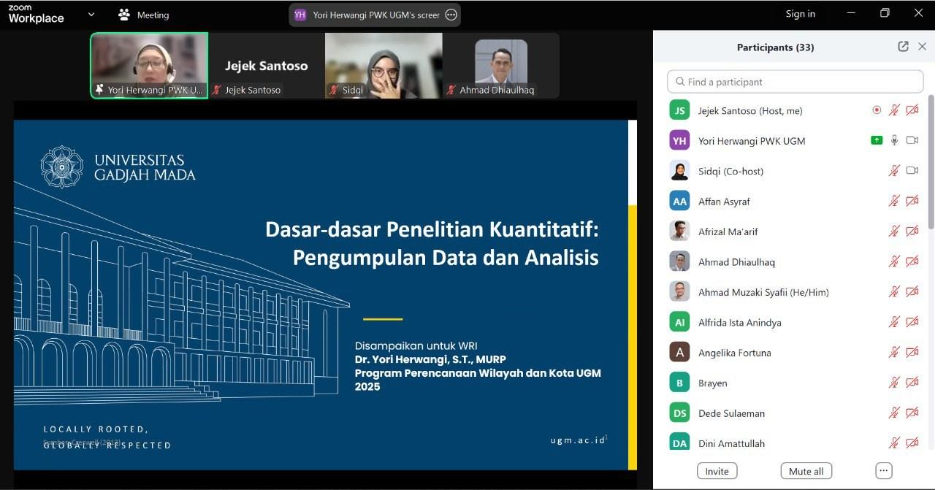
July 23, 2025 – Dr. Yori Herwangi, S.T., M.URP., served as a guest speaker in a training session organized by the World Resources Institute (WRI) Indonesia, a research organization known for its approach of “Count It, Change It, and Scale It” in driving impact through data-based research. The training was held online via Zoom from 10.00 to 12.00 WIB.
In this session, Dr. Yori presented a topic titled Basic Applied Quantitative Research: Data Collection and Analysis. She began by introducing the fundamentals of quantitative, qualitative, and mixed-method research, explaining their characteristics and types. She then delved into quantitative analysis methods, covering descriptive and inferential statistics. The presentation also included explanations of univariate, bivariate, and multivariate statistics, supported by real-world examples to help participants better grasp the concepts.
How do we care for a living world heritage site? Not merely by admiring it, but by deeply understanding it, this is exactly what the participants of this program aimed to do.
Yogyakarta, a city rich in cultural heritage, once again captured international attention. The city’s Cosmological Axis and its surrounding historic landmarks are key elements recognized by UNESCO. In an effort to strengthen conservation efforts and deepen understanding of this heritage, the UGM-UNESCO Chair in Heritage Cities Conservation and Management, in collaboration with the Yogyakarta Municipality Government, Kanki Laboratory, and the Jogja Heritage Society, held the 2nd International Field School on the Cosmological Axis of Yogyakarta and Its Historic Landmarks: Conservation and Management of the Buffer Zones. The five-day field school, held from 14 to 18 July 2025, took place in multiple key locations: the Department of Architecture and Planning, Faculty of Engineering, Universitas Gadjah Mada; Yogyakarta Municipality Office; four subdistricts (Kadipaten, Patehan, Panembahan, and Ngupasan) within the buffer zone; and various points along the Cosmological Axis of Yogyakarta.
Amid the growing concerns around mental health in major cities, a crucial question arises: are our cities truly designed for people?
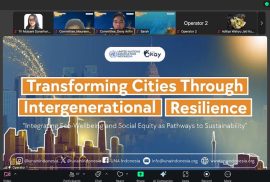
July 20, 2025—Addressing this issue, Dr. Ir. Tri Mulyani Sunarharum, S.T., a lecturer and researcher from the Department of Architecture and Planning, Faculty of Engineering, Universitas Gadjah Mada, delivered a powerful message in a national discussion forum titled Transforming Cities Through Intergenerational Resilience: Integrating Eco-Wellbeing and Social Equity as Pathways to Sustainability. The event, initiated by I AM OKAY X UNA Indonesia, was held via Zoom and brought together speakers from various disciplines, all with a shared concern for sustainable urban development.
Master’s students of Architecture, Class of 2024, Architectural Design Concentration, Universitas Gadjah Mada, successfully held their final Studio presentation on Monday, June 16, 2025. In this event, each student participated in a display and exhibition to present their works as the outcome of the Studio 1 Architectural Design course, which has been carried out over the past semester.
Throughout the course, students were divided into two thematic groups: the “shadow” group and the “corner” group. Three lecturers guided the students in developing these themes: Harry Kurniawan, S.T., M.Sc., Ph.D. (supervisor for the “corner” theme); Dr.Eng. Alexander Rani Suryandono, S.T., M.Arch. (supervisor for the “shadow” theme); and Ar. Arief Isrefidianto, S.T., MAUD., IAI (supervisor for both themes).
On Tuesday, June 16, 2025, six Master’s students of Architecture (Class of 2024), Universitas Gadjah Mada, who are enrolled in the Studio 2 course within the Architectural Design Research Group (KBK Desain Arsitektur), conducted their final presentations showcasing the research they had undertaken throughout the semester.
Each student carried out a semester-long research project under the supervision of the KBK Architectural Design faculty members: Prof. Ir. Tarcicius Yoyok Wahyu Subroto, M.Eng., Ph.D., IPU; Diananta Pramitasari, S.T., M.Eng., Ph.D.; Syam Rachma Marcillia, S.T., M.Eng., Ph.D.; Mario Lodeweik Lionar, S.T., M.Sc., Ph.D.; and Odilia Renaningtyas Manifesty, S.T., MA(UD)., Ph.D.
In response to the challenges of climate change and energy efficiency in tropical urban environments, the Department of Architecture and Planning, Faculty of Engineering, Universitas Gadjah Mada (UGM) has conducted an experimental study focused on the implementation of a green wall system on a campus building. The research, titled “Effect of Greenwalls on Building Energy Use and Urban Heat Island: Insights from a Campus-Based Case Study on Facade Systems, Plant Performance, User Perceptions, and Social-Educational Impact,” provides an in-depth evaluation of the vertical garden installed on the east-facing facade of the Department’s three-story building, examining its technical, environmental, and socio-educational impacts.
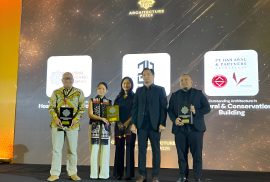
Architect and professional practitioner Ir. Adi Utomo Hatmoko, M.Arch., who also serves as a lecturer at the Architecture and Planning Department, Universitas Gadjah Mada (UGM), has once again achieved national recognition. His design for the Bali International Hospital received the highest recognition for architectural masterpieces in the Hospital and Healthcare category from IndoBuildTech on July 4, 2025. This award highlights the excellence of the design concept, the precision in planning, and the contribution of architecture to sustainability and quality of life.
Efforts to find sustainable solutions in architecture are no longer limited to land-based development, but now also extend to coastal and marine environments. In response to this growing challenge, the Undergraduate Architecture Program at Universitas Gadjah Mada (UGM) has partnered with the University of Nottingham Malaysia (UNM) and Universiti Teknologi PETRONAS (UTP) to offer a collaborative elective course titled Floating Architecture. The course was held during the even semester of the 2024/2025 academic year, and was designed to broaden students’ perspectives on the potential for human life at sea, and how architecture can contribute sustainable solutions in this context.