
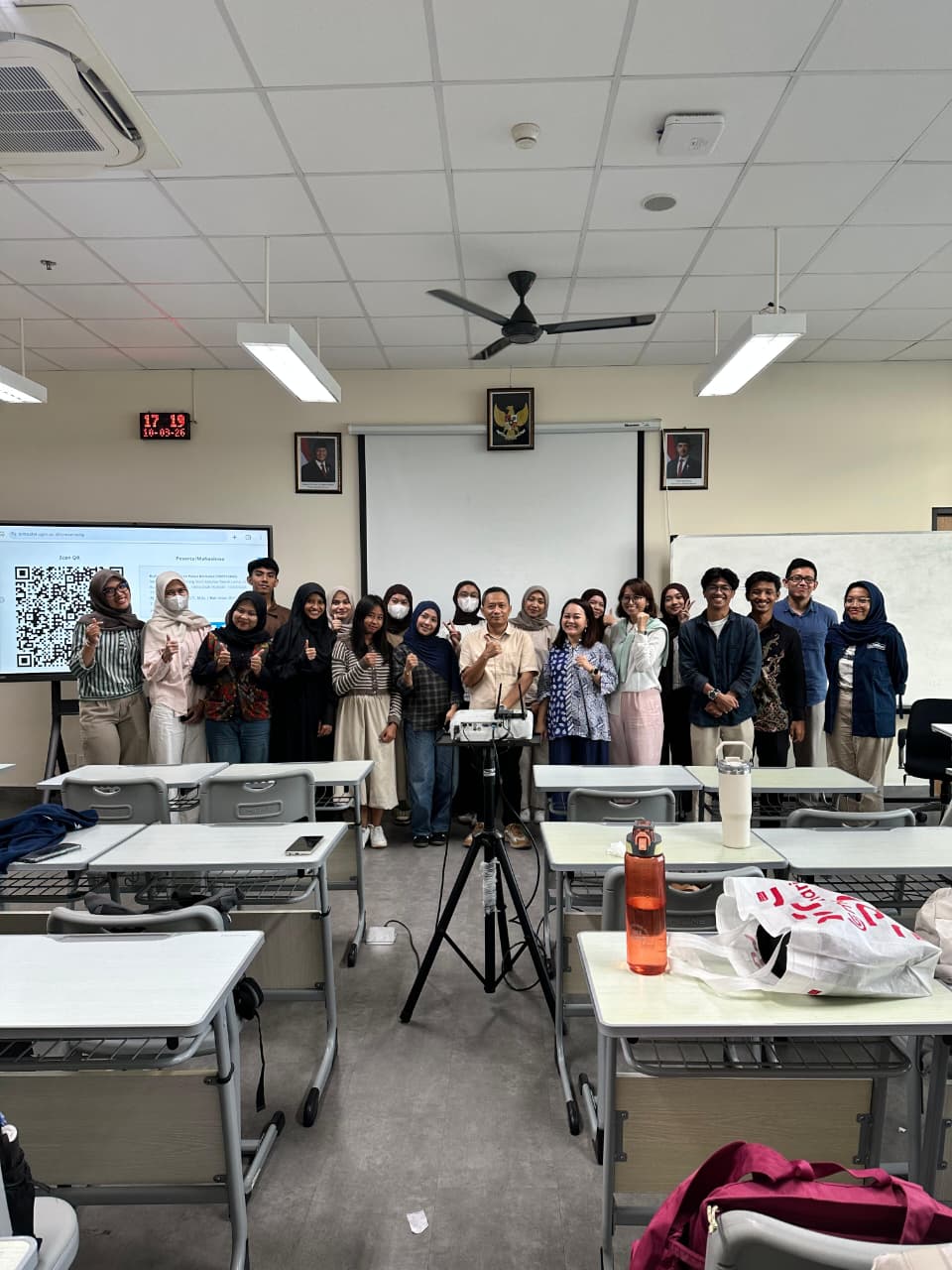
The Urban and Regional Planning Program (PWK) at Universitas Gadjah Mada (UGM) recently held a guest lecture exploring both the technical and human aspects of post-disaster management. Featuring Ir. Ashar Saputra, Ph.D., IPM from the Department of Civil and Environmental Engineering, UGM, the discussion highlighted the complexity of regional recovery efforts in Sumatra following devastating flood events.
In his presentation, Dr. Ashar emphasized that recovery is not merely about rebuilding what has been damaged, but about implementing the Build Back Better principle. He highlighted real challenges encountered in the field, including logistical constraints, debris removal, and limited access to construction materials in remote areas. One notable aspect discussed was the importance of locality-based approaches, where during emergency situations, flood-drifted wood can be creatively reused to construct environmentally friendly temporary shelters while actively involving disaster survivors in the recovery process.
The discussion provided valuable insights for planning students that post-disaster spatial planning must be dynamic and adaptive. Reconstruction is not only about rebuilding physical structures but also about restoring social and economic activities through appropriate technologies and resilient designs capable of addressing future disaster risks.
This guest lecture is closely related to several Sustainable Development Goals (SDGs). It supports SDG 11 (Sustainable Cities and Communities) through strengthening the resilience of post-disaster infrastructure and housing, as well as SDG 13 (Climate Action) through adaptation and mitigation strategies for increasing hydrometeorological disaster risks. Furthermore, the activity contributes to SDG 9 (Industry, Innovation, and Infrastructure) through innovations in selecting resilient construction materials and technologies, and SDG 12 (Responsible Consumption and Production) through the utilization of local and recycled materials, such as flood-drifted wood, for construction purposes. The activity also aligns with SDG 17 (Partnerships for the Goals) by encouraging collaboration among academics, government, and communities in disaster risk management and recovery efforts.


This article is reproduced from:
Author: Jillan Sausan Amira
Editor: Rindi Dwi Cahyati
Tags:
SDG 9 – INDUSTRY, INNOVATION, AND INFRASTRUCTURE
SDG 11 – SUSTAINABLE CITIES AND COMMUNITIES
SDG 12 – RESPONSIBLE CONSUMPTION AND PRODUCTION
SDG 13 – CLIMATE ACTION
SDG 17 – PARTNERSHIPS FOR THE GOALS