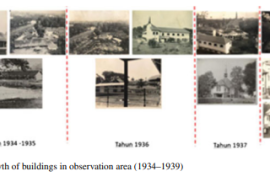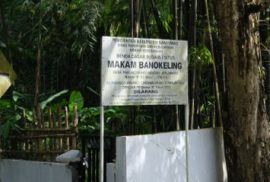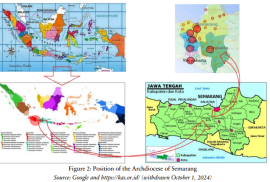
A study examining conservation strategies for colonial-era religious and educational complexes in the Archdiocese of Semarang through the Historic Interpretation Strategy (HIS) approach has been published in an international journal. The research was published in Social Sustainability in Economic, Social, and Cultural. The article by Rosalia Rachma Rihadiani, together with Prof. Ir. Sudaryono, M.Eng., Ph.D., IPU. as Promotor and Dr.Eng. Ir. Laretna Trisnantari Adishakti, M.Arch. as Co-Promotor, can be accessed through: https://doi.org/10.18848/2325-1115/CGP/v22i01/63-86. The research, entitled “Historical Collective Memory as a Strategy for Architectural Conservation in the Archdiocese of Semarang: A Case Study of Yogyakarta, Surakarta, Muntilan, Ambarawa, and Semarang,” highlights that architectural conservation is not limited to the physical aspects of buildings, but also involves collective memory, historical values, and spatial meanings that continue to evolve within society.
SDGs
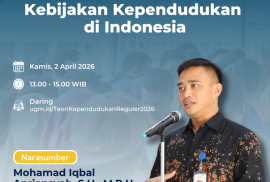
On April 2, 2026, the Urban and Regional Planning Program (PWK) at Universitas Gadjah Mada had the opportunity to explore population issues directly from a practitioner’s perspective. Mohamad Iqbal Apriansyah, S.H., M.P.H., Head of the Representative Office of BKKBN Yogyakarta Special Region, delivered a presentation on Indonesia’s population policy direction amid increasingly complex social dynamics.
The guest lecture highlighted that spatial planning cannot be separated from demographic conditions and human quality. Mr. Iqbal presented various strategic intervention programs, ranging from the “Genting” (Foster Parents to Prevent Stunting Movement) program, which aims to ensure the quality of future generations, to the “Tamasya” (Child Care Park) program, which supports a standardized child-care ecosystem. In addition, the issue of fatherlessness in Indonesia was addressed through the Gerakan Ayah Teladan Indonesia (GATI), emphasizing the important role of fathers in strengthening family resilience.
Doctoral students from the Architecture Study Program, Department of Architectural Engineering and Planning (DTAP), Faculty of Engineering, Universitas Gadjah Mada (UGM), continue to strengthen their academic contributions through research publications in internationally reputable Scopus-indexed journals. Two recent studies highlight different architectural issues, ranging from architectural education to heritage conservation.
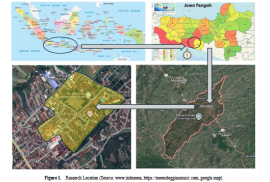
The research article titled “Evaluating relationships between hand-drawing ability and design performance: Case of Architecture Study Program UGM” was authored by Kadek Indira Diah Kardina, Labdo Pranowo, Nur Zahrotunnisaa Zagi, and Dijeng Dwi Putri, together with lecturers Mario Lodeweik Lionar, S.T., M.Sc., Ph.D. and Harry Kurniawan, S.T., M.Sc., Ph.D. The article was published in the international journal ARTEKS: Journal of Architecture. This study examines the relationship between hand-drawing ability and architecture students’ design performance. Using a quantitative correlation-based approach, the research demonstrates that visual representation skills play an important role in supporting creative thinking processes and architectural design development while considering the context of architectural education. The full article can be accessed through the following link: https://journal.unwira.ac.id/index.php/ARTEKS/article/view/2841.
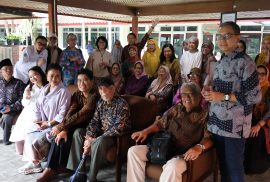
The Department of Architecture and Planning Engineering (DTAP), Faculty of Engineering, Universitas Gadjah Mada, held a Syawalan 1447 H gathering on Monday, March 30, 2026. The event commenced at 10:30 AM (WIB) at Pendopo Tedjo Suminto, DTAP FT UGM, serving as an important occasion to strengthen ties among the entire DTAP community.
The Syawalan was attended by various members of the DTAP academic community, ranging from department leadership to retired members and their families. Attendees included the Head and Secretary of the Department, Heads and Secretaries of Study Programs, active and retired academic staff, active and retired administrative staff, teaching assistants, as well as the extended DTAP family. This cross-generational presence reflects the strong sense of belonging and enduring familial bonds within DTAP.
The Urban and Regional Planning Program (PWK) at Universitas Gadjah Mada continues to equip students with awareness of current trends in spatial technology. In its latest guest lecture, PWK UGM invited Nugroho Purwono, M.URP., Junior Expert Researcher from the National Research and Innovation Agency (BRIN), to discuss the important topic “Spatial Big Data in Urban & Regional Planning: Data Analysis Methods and Techniques.”
Nugroho opened the session by explaining that approximately 80% of data produced by society today fundamentally contains spatial dimensions. This includes automatically attached coordinates (natively geocoded) from digital devices, as well as geographical metadata generated from daily activities and transactions.
February 13, 2026 – The Architecture Study Program of Universitas Gadjah Mada hosted the event “99% Abstraksi: Voice of The Village – Eko Prawoto”, organized by the Yayasan Eko Agus Prawoto (YEAP) in collaboration with UGM, the Indonesian Institute of Architects (IAI) DIY, and OMAH Library. The event was held in a hybrid format for approximately three hours and was attended by practitioners, academics, and architecture students from various regions, both onsite and online.
The event opened with welcoming remarks from Krisna Thahja, representing the Yayasan Eko Agus Prawoto, who attended in person. Participants also watched a recorded message from Rinawati Adhypranata, the wife of the late Eko Prawoto. Her remarks served as a reflective moment, reminding the audience of Eko Prawoto’s figure and contributions to Indonesian architecture.
The Urban and Regional Planning Program (PWK) at Universitas Gadjah Mada (UGM) recently held a guest lecture exploring both the technical and human aspects of post-disaster management. Featuring Ir. Ashar Saputra, Ph.D., IPM from the Department of Civil and Environmental Engineering, UGM, the discussion highlighted the complexity of regional recovery efforts in Sumatra following devastating flood events.
In his presentation, Dr. Ashar emphasized that recovery is not merely about rebuilding what has been damaged, but about implementing the Build Back Better principle. He highlighted real challenges encountered in the field, including logistical constraints, debris removal, and limited access to construction materials in remote areas. One notable aspect discussed was the importance of locality-based approaches, where during emergency situations, flood-drifted wood can be creatively reused to construct environmentally friendly temporary shelters while actively involving disaster survivors in the recovery process.
In the first quarter of 2026, the Department of Architecture and Planning Engineering (DTAP), Faculty of Engineering, Universitas Gadjah Mada (UGM), officially graduated 17 undergraduate students. This cohort consists of 11 graduates from the Architecture Study Program and 6 graduates from the Urban and Regional Planning (URP) Study Program. The February 2026 graduation period marks an important milestone for students who have successfully completed their academic journey.
From the Architecture Study Program, graduates achieved a GPA ranging from 3.10 to 3.70, with an average GPA of 3.42. The highest GPA was earned by Raihan Lazuardi Suyono (Class of 2021), who achieved a GPA of 3.70. The average study duration was 4 years and 11 months, while the fastest completion time was 4 years and 1 month, accomplished by Bening Putri Kasandra. The youngest graduate in this period was Chantal Maheeyaridy, aged 21 years and 10 months.
The Undergraduate Program in Urban and Regional Planning (PWK), Universitas Gadjah Mada (UGM), reaffirmed its commitment to delivering globally standardized education through the ASIIN re-accreditation site visit held on February 11–12, 2026. The visit was conducted by ASIIN (Akkreditierungsagentur für Studiengänge der Ingenieurwissenschaften, der Informatik, der Naturwissenschaften und der Mathematik), an independent German accreditation agency.
This visit marked an important moment for the study program to reflect on its educational quality and institutional performance. The assessment team consisted of Prof. Dr. Frank Schwartze, Prof. Dr. Detlef Kurth, Dr. Hendricus Andy Simarmata, Aurelia Nadya Utomo, and Tamina Renner, M.A.
Spatial Planning Strategies and Regional Transformation of Magelang Regency in PWK UGM Guest Lecture
The Undergraduate Program in Urban and Regional Planning (PWK), Universitas Gadjah Mada, once again held a guest lecture focusing on the spatial dynamics of Magelang Regency. The session featured Dhanik Ernawati, S.T., M.Eng., an expert from the Regional Development Planning, Research, and Development Agency (BAPPEDA & LITBANGDA) of Magelang Regency. She delivered a presentation titled “Spatial Planning for Enhancing the Competitiveness of Magelang Regency”.
In her presentation, Ms. Dhanik elaborated on the latest spatial policy direction formalized through Regional Regulation No. 7 of 2024 on the 2024–2044 Spatial Plan (RTRW) of Magelang Regency. Often described as a “water bowl” due to its topographical form, Magelang Regency exhibits diverse spatial potentials. The western and northern mountainous areas are designated for agriculture and nature-based tourism, while the central region serves as a hub for trade and industrial activities. Meanwhile, the eastern areas are identified for C-class mining activities. This spatial framework is designed to support the regency’s vision of being safe, comfortable, religious, competitive, and prosperous.