The Doctoral Program in Architecture of the Department of Architecture and Planning (DTAP), Faculty of Engineering, Universitas Gadjah Mada (UGM), has once again achieved a significant academic milestone through the publication of two scientific works in reputable international publications. These publications demonstrate the contribution of the academic community of the Doctoral Program in Architecture to addressing various global challenges, ranging from indoor thermal comfort to the conservation of cultural and natural heritage.
SDGs 11-Sustainable Cities & Communities
As part of the learning activities in the Research Methodology 2 course, students from the Master of Architecture Program, Faculty of Engineering, Universitas Gadjah Mada (UGM), conducted a field study in several areas of Pekuncen Village, Jatilawang District, Banyumas Regency, Central Java. This activity became an important stage in the field research-based learning process to deepen students’ understanding of the phenomenological approach in architecture and the built environment.
The field study aimed to collect data and information regarding spatial phenomena, building conditions, and cultural practices developed within Pekuncen Village. The observation focused on the relationship between space, social activities, and cultural values embedded in the community. The collected data will serve as the foundation for students’ research assignments in the Research Methodology 2 course.
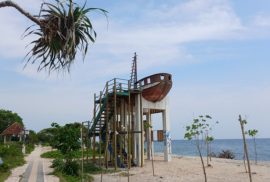
As part of the learning process in the Studio 1 Contextual Exploration course, students from the Master of Architecture Program, Tourism Architecture Concentration, Faculty of Engineering, Universitas Gadjah Mada (UGM), conducted a field survey at Bandengan Beach Area, Jepara Regency, from 7–10 May 2026. The activity served as an important stage in preparing the Master Plan for the Tourism Attraction Area (ODTW) of Bandengan Beach, with a planning horizon from 2025 to 2035.
Recognized as one of Jepara’s leading coastal tourism destinations, Bandengan Beach plays a strategic role as one of the largest contributors to the tourism sector’s Regional Original Revenue (PAD). This potential makes the area a relevant learning laboratory for tourism architecture students to understand the dynamics of marine tourism development through a contextual, sustainable, and locally based approach.
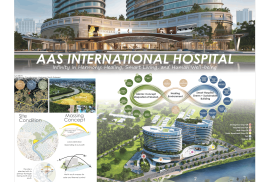
Adi Utomo Hatmoko, a lecturer from the Department of Architecture and Planning (DTAP), Faculty of Engineering, Universitas Gadjah Mada (UGM), together with his team, won the AAS International Hospital Design Competition located in Panaikang, Panakkukang District, Makassar, South Sulawesi. The competition winners were officially announced at the end of April 2026.
Through their proposal entitled “AAS International Hospital: Infinity in Harmony – Healing, Smart Living, and Human Well-being,” the team introduced the concept of an integrated healthcare development that combines medical services, residential facilities, hospitality functions, and commercial spaces within a modern and interconnected environment. The design was developed with a strong emphasis on user comfort and well-being as the central focus of the project.
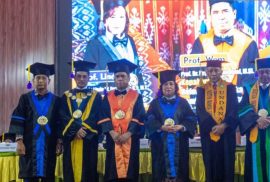
Prof. Dr. Linda W. Fanggidae, S.T., M.T., an alumna of the Architecture Doctoral Program, Universitas Gadjah Mada (UGM), cohort of 2016, has been appointed as a Professor at Universitas Nusa Cendana. This achievement highlights the contribution of UGM Architecture doctoral alumni to the development of architectural knowledge in Indonesia.
In her inaugural professorial address delivered on April 8, 2026, Prof. Linda presented a speech entitled “Architecture and Behavior: Building Spaces for the Human Soul, Interpreting from Pruitt-Igoe to Kios Angalai”. The lecture highlights the relationship between architecture, human behavior, and spatial experience, emphasizing that architecture is not merely about physical form, but also about how space shapes human interaction, meaning, and lived experience.
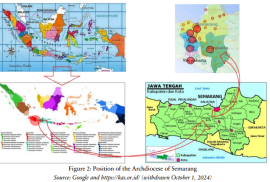
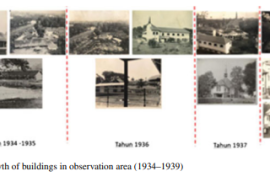
A study examining conservation strategies for colonial-era religious and educational complexes in the Archdiocese of Semarang through the Historic Interpretation Strategy (HIS) approach has been published in an international journal. The research was published in Social Sustainability in Economic, Social, and Cultural. The article by Rosalia Rachma Rihadiani, together with Prof. Ir. Sudaryono, M.Eng., Ph.D., IPU. as Promotor and Dr.Eng. Ir. Laretna Trisnantari Adishakti, M.Arch. as Co-Promotor, can be accessed through: https://doi.org/10.18848/2325-1115/CGP/v22i01/63-86. The research, entitled “Historical Collective Memory as a Strategy for Architectural Conservation in the Archdiocese of Semarang: A Case Study of Yogyakarta, Surakarta, Muntilan, Ambarawa, and Semarang,” highlights that architectural conservation is not limited to the physical aspects of buildings, but also involves collective memory, historical values, and spatial meanings that continue to evolve within society.
Doctoral students from the Architecture Study Program, Department of Architectural Engineering and Planning (DTAP), Faculty of Engineering, Universitas Gadjah Mada (UGM), continue to strengthen their academic contributions through research publications in internationally reputable Scopus-indexed journals. Two recent studies highlight different architectural issues, ranging from architectural education to heritage conservation.
The research article titled “Evaluating relationships between hand-drawing ability and design performance: Case of Architecture Study Program UGM” was authored by Kadek Indira Diah Kardina, Labdo Pranowo, Nur Zahrotunnisaa Zagi, and Dijeng Dwi Putri, together with lecturers Mario Lodeweik Lionar, S.T., M.Sc., Ph.D. and Harry Kurniawan, S.T., M.Sc., Ph.D. The article was published in the international journal ARTEKS: Journal of Architecture. This study examines the relationship between hand-drawing ability and architecture students’ design performance. Using a quantitative correlation-based approach, the research demonstrates that visual representation skills play an important role in supporting creative thinking processes and architectural design development while considering the context of architectural education. The full article can be accessed through the following link: https://journal.unwira.ac.id/index.php/ARTEKS/article/view/2841.
February 13, 2026 – The Architecture Study Program of Universitas Gadjah Mada hosted the event “99% Abstraksi: Voice of The Village – Eko Prawoto”, organized by the Yayasan Eko Agus Prawoto (YEAP) in collaboration with UGM, the Indonesian Institute of Architects (IAI) DIY, and OMAH Library. The event was held in a hybrid format for approximately three hours and was attended by practitioners, academics, and architecture students from various regions, both onsite and online.
The event opened with welcoming remarks from Krisna Thahja, representing the Yayasan Eko Agus Prawoto, who attended in person. Participants also watched a recorded message from Rinawati Adhypranata, the wife of the late Eko Prawoto. Her remarks served as a reflective moment, reminding the audience of Eko Prawoto’s figure and contributions to Indonesian architecture.
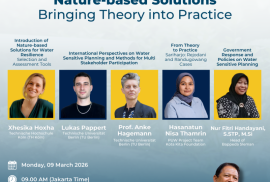
The rapid pace of urbanization and the growing challenges of climate change require urban planners to continuously seek innovative approaches, particularly in strengthening environmental resilience and managing water resources. Responding to these challenges, the Department of Architectural Engineering and Planning at Universitas Gadjah Mada (UGM) successfully organized an Academic Workshop titled “Nature-based Solutions: Bringing Theory into Practice” on Monday, March 9, 2026, at the Meeting Room, 2nd Floor, Department of Architectural Engineering and Planning.
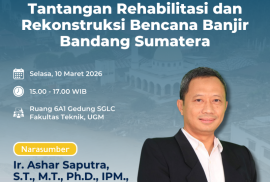
The Urban and Regional Planning Program (PWK) at Universitas Gadjah Mada (UGM) recently held a guest lecture exploring both the technical and human aspects of post-disaster management. Featuring Ir. Ashar Saputra, Ph.D., IPM from the Department of Civil and Environmental Engineering, UGM, the discussion highlighted the complexity of regional recovery efforts in Sumatra following devastating flood events.
In his presentation, Dr. Ashar emphasized that recovery is not merely about rebuilding what has been damaged, but about implementing the Build Back Better principle. He highlighted real challenges encountered in the field, including logistical constraints, debris removal, and limited access to construction materials in remote areas. One notable aspect discussed was the importance of locality-based approaches, where during emergency situations, flood-drifted wood can be creatively reused to construct environmentally friendly temporary shelters while actively involving disaster survivors in the recovery process.